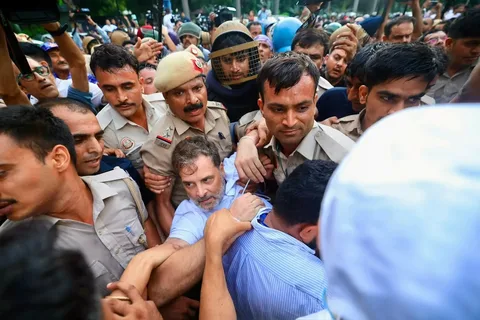
Police in New Delhi briefly detained Indian opposition leader Rahul Gandhi on Tuesday during a march demanding the resignation of the country’s chief election commissioner. His sister, Priyanka Gandhi Vadra, and other opposition lawmakers were also held, according to Reuters. The march targeted the Election Commission of India (ECI) over a disputed revision of voter lists. Rahul Gandhi and the others were released soon afterwards.
Background: The Voter List Dispute
The protests focus on Chief Election Commissioner Gyanesh Kumar and a revision of electoral rolls that opposition parties say was carried out unfairly. They argue that the process has raised concerns about the commission’s neutrality. The ECI rejects the allegations and says the exercise is meant to make voter records more accurate and reliable.
Demonstrations began last Friday, according to Dawn, with opposition members calling for Kumar to step down. Student groups and a youth-led campaign have also taken part in some protests, according to news reports. Police used tear gas against some demonstrators at an earlier protest.
The matter has also reached the courts. Pakistan Observer reported that on Monday, India’s top court agreed to hear petitions seeking judicial intervention over the voter-roll exercise and the conduct of the election chief. That makes the political fight a legal one as well.
Rahul Gandhi is the Leader of Opposition in India’s lower house of parliament and a senior leader of the Congress party. He has been detained during protests before. In July 2022, police held him along with other Congress leaders after a march toward the presidential palace.
Details: What Happened on Tuesday
Dozens of opposition lawmakers began a march from Parliament toward the Election Commission headquarters. Hundreds of security personnel, including members of the Rapid Action Force, stood guard in central Delhi. Barricades were set up, and authorities advised people against travelling around the protest area and closed some routes.
Police stopped the march at the barricades. Television channels reported that officers detained Rahul Gandhi, Priyanka Gandhi Vadra and other lawmakers when they tried to breach them. An AFP reporter saw Rahul Gandhi standing on a barricade and waving the Indian flag before he was taken away.
Police did not immediately comment on the detentions. The lawmakers were released shortly afterwards, according to Dawn and other outlets. The Election Commission office remained barricaded, with security personnel carrying batons outside.
Government and Commission Response
The Election Commission and the ruling Bharatiya Janata Party (BJP) of Prime Minister Narendra Modi have denied the opposition’s accusations. Kumar has not commented publicly on the issue, according to Reuters. The commission says the revision is routine and intended to improve accuracy.
The government has not announced any change in the commission’s leadership. Opposition leaders say they will continue their campaign. How the courts handle the petitions may influence what happens next.
Quotes: What Each Side Says
Opposition leaders say the election body has lost its independence and must answer questions about the voter-list exercise. They say the commission should act as a neutral referee, not as a party to the dispute. These claims are the opposition’s position and have not been proven.
The Election Commission says the revision is meant to make records more accurate. The BJP says the opposition’s charges are baseless. No official statement from the police explaining the reason for the detentions had been seen in the reports reviewed.
Impact: Why the Protest Matters
For Indian politics, the protest shows how sharply divided the government and opposition are over election integrity. Trust in the election system is central to democracy, so any doubt can have wide effects. A court ruling could either calm the dispute or add fuel to it.
For the Congress party, the detention of its senior leaders gives it a high-profile moment in the capital. It also puts pressure on the government to explain the voter-list process. Supporters of the government see the protests as political theatre.
Internationally, the story attracts attention because India is the world’s largest democracy. Observers often watch how it handles dissent, policing of protests and the independence of its institutions. Reports from outlets such as Reuters, Dawn and Pakistan Observer show that the event is being followed in neighbouring countries too.
Conclusion: What Comes Next
The Supreme Court hearing on the petitions is the key next step. The opposition may plan more marches, and the government may face pressure to answer questions in Parliament. The commission may also issue a public response.
Much depends on whether the courts order any changes to the voter-list process. Until then, the dispute is likely to continue. Rahul Gandhi’s detention may be brief, but the argument behind it is far from over.
Frequently Asked Questions (FAQs)
Is Rahul Gandhi married? Who is Rahul Gandhi’s wife?
Rahul Gandhi is not married, as far as public records and reports show. He has not announced a marriage, and there is no official record of a wife. He has often said little about his personal life in interviews. If you see claims online about a wife or partner, treat them with caution unless they come from a reliable source or from him directly. His close family includes his mother, Sonia Gandhi, and his sister, Priyanka Gandhi Vadra, who was detained alongside him on Tuesday.
Who is Rahul Gandhi’s father?
Rahul Gandhi’s father was Rajiv Gandhi, who served as India’s prime minister from 1984 to 1989. Rajiv Gandhi was assassinated in 1991 while campaigning for elections in Tamil Nadu. Rahul Gandhi’s mother, Sonia Gandhi, later became president of the Congress party and led it for many years. His grandmother, Indira Gandhi, and great-grandfather, Jawaharlal Nehru, were also prime ministers. This family background is one reason Rahul Gandhi is closely watched in Indian politics, though he has built his own career as a Member of Parliament and opposition leader.
How old is Rahul Gandhi, and what was he like when young?
Rahul Gandhi was born on June 19, 1970, in New Delhi, which makes him 56 years old. He grew up in a prominent political family and lost his grandmother, Indira Gandhi, and father, Rajiv Gandhi, to assassinations while he was still young. He studied abroad and later entered politics, winning a seat in Parliament in 2004. He has since led the Congress party at various stages and is now Leader of Opposition in the lower house. For his full biography, check reliable sources such as the Indian Parliament’s website or established news outlets.